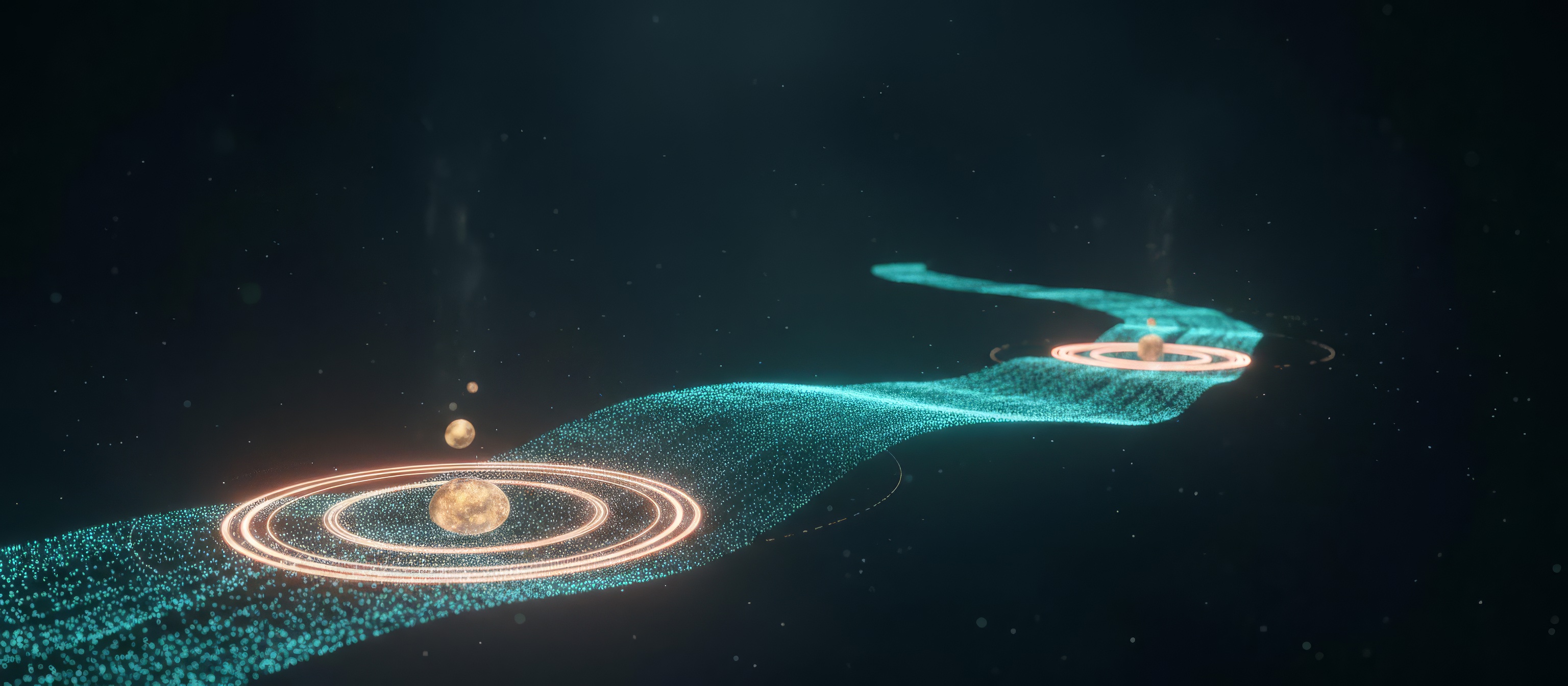
River of Intelligence - The Glimpse into Future of Work
Andrej Simunaj
For all of history, the world’s intelligence was 100% human. That era is ending. What happens when most of the world’s intelligence is AI? I’ve spent the last year living inside what comes next, and I can tell you what the day actually feels like.
Interactive
The same river, running live. Drop a pebble in and watch the current bend around it.
Open the model →
For all of human history, the world ran on one kind of intelligence. Ours.
Eight billion minds. Every discovery, every cathedral, every line of code, every terrible decision and every brilliant one, all of it came from the same source: the three pounds of tissue behind a human face. It is a staggering amount of intelligence. And it has a ceiling.
You cannot copy a mind. You cannot deploy a single genius into a thousand rooms at once. Human intelligence is bounded by biology and by headcount. It grows only as fast as we can raise and teach new people, and it stops the moment we fall asleep. Enormous, yes. But fixed.
Artificial intelligence is not like that.
A machine mind can be copied a million times before lunch and set to work in a million places at once. It doesn’t tire, doesn’t graduate, doesn’t retire. And in many domains it is already smarter than us. Not “one day.” Now. Today’s models reason at the level of a PhD in fields that would take you a decade to enter. They are wildly uneven, what researchers call the jagged frontier: clumsy at things a child finds trivial, superhuman at things that would break an expert. But where they are strong, they are already far past us. And that intelligence is being poured into the world and put to work: operationalized as agents that do real tasks, ship real output, hold real jobs.
So the world’s useful work is no longer 100% human. It’s split. We still do most of it. Agents do a slice, small today, growing fast.
Now extrapolate. Not wildly. Just follow the curve.
Soon, the intelligence operating in the world will be 99.9% artificial, not because we got dumber, but because the other side has no ceiling and we do.
Fig. 1
The composition of intelligence over time
Which leaves one question, and for anyone who works for a living, it is the only one that matters:
When the machines hold nearly all the intelligence, what is left for us to do?
I have a partial answer. Not from a whitepaper. From my experience. I’ve spent the last year living an early, working version of that future, and I know how the work feels.
The Long Climb
I’ve been quietly elevating myself, one level at a time
I build multi-agent systems. The harness I run them on is CRHQ.ai, as complete a system for orchestrating fleets of AI agents as exists anywhere right now. But the interesting part isn’t the software. It’s what running it has done to my job.
Over the past year I’ve been climbing a ladder. Each level changed less about the agents and more about me: where I sit, what I decide, how much I touch. Let me walk you up it.
Level one: one agent, one conversation. You open a session and talk to a single agent. It’s capable, but it’s yours to steer, turn by turn. You ask, it does, you correct, it redoes. This is where nearly everyone who has touched AI lives today. It’s genuinely useful. It’s also a leash: the agent goes exactly as far as your next instruction and not one step further. You are the operator.
Level two: a brain that learns. The agent stops needing me for everything. I hand it strategy instead of instructions, and it starts making its own calls, surfacing only the decisions it truly can’t make without me. I stopped operating and started directing. My hands left the wheel; I kept the map. Operator became strategist.
Level three: the swarm. This is where it gets strange, in the best way. A lead agent sits on top of a team of specialists and runs them. My Transcript API marketing operation is a swarm: an SEO manager, a backlink-builder, a B2B outreach agent, a developer, a customer-support agent, and more, each excellent at one thing, all coordinated by a lead agent that manages them, answers their questions, and makes most of the calls I used to make myself. I give direction. It gives orders. I now make maybe one decision in ten. The swarm makes the other nine.
Where I Am Now
This is where I am right now
Right now I manage about a dozen of these at once:
- the Transcript API marketing agent
- the ZillAPI marketing agent
- the YouTube to Transcript ad manager agent
- a web network builder agent that ships several new SEO websites every week, across directories, travel sites, and affiliate marketing sites
- development swarms that build new products and maintain and build client projects
I jump between them, making high-level decisions. And honestly, a lot of the work is giving them access to things they cannot reach yet: managing DNS, email addresses, third-party marketing tools, and other integrations.
But I am at my limits on how many swarms I can manage. So where do we go from here?
Level four: the swarm of swarms. Many swarms, each with its own manager, under a manager of managers. I’ll be honest: I’m not fully here yet. I’m still learning to run swarms so they stay well-calibrated, so their ambition matches their ability and they don’t quietly overreach. This is the frontier I’m standing on right now. It’s humbling. It’s also, plainly, the direction.
Notice the pattern. At every level I do less and the system does more. My share of the decisions shrinks while the total output multiplies. Operator, to strategist, to director, and at each step up, I let go of more.
Fig. 2
The elevation ladder
The Decision Budget
You have about a hundred real decisions in you a day
Here’s the model that makes all of this concrete.
You have a finite number of real decisions in you each day. Call it a hundred: the meaningful ones, the judgment calls, the this, not that. It’s a budget, and it’s smaller than you think.
Now do the math on agents. If one agent needs a hundred decisions from you a day, that agent has spent your entire budget. You are fully consumed by a single worker. Add a second, and something breaks: two agents each wanting a hundred decisions ask for two hundred, and you have one hundred to give. Five agents? Now they sit idle, waiting on you, four hundred decisions deep in a queue you can’t clear. You didn’t multiply your output. You became the bottleneck.
This is the wall every ambitious person hits with AI, usually without naming it. More agents don’t help if each one still needs all of you.
Elevation is the way through. A brain that decides for itself drops its ask from a hundred to twenty. A swarm with a lead agent drops it to ten, then five. Suddenly your hundred decisions aren’t trapped feeding one worker. They’re free. And you get to spend them where they matter most.
The game stops being "how much work can I do." It becomes "where do I place my scarce, expensive judgment so it moves the most."
That reframe is the future of work in a single line.
The River of Intelligence
A current of intelligence, and the pebbles I drop in it
Here is how it actually feels, day to day. This is the image I can’t shake.
Picture a river. A wide, constant current of intelligence, flowing on its own, day and night, and 99.9% of it artificial. It doesn’t wait for me. The agents work while I sleep, while I’m at dinner, while I’m somewhere with my phone in my pocket. The current never stops. Work gets done in the dark.
And every so often, I walk up to the bank and drop in a pebble.
A pebble is small: a nugget of judgment, a note, a “no, do it this way,” a “yes, keep going.” Nothing more than a thought. But the river takes it and bends. My input is tiny by volume and enormous by weight, because the agents treat it as the final word, always taken on board, disproportionately powerful relative to its size. One pebble, and the whole current changes course.
Last week this stopped being a metaphor. My Transcript API agents had been running without me, writing, testing, queuing up their outputs and the few decisions they needed me to weigh in on. I’d been away. When I found a spare few minutes I opened the review, skimmed it, and left one short piece of feedback. That was the pebble. By the time I looked again, the entire swarm had reoriented: plans redrawn, the work now flowing toward where my note had pointed. I was gone. The river kept moving. My pebble changed its course.
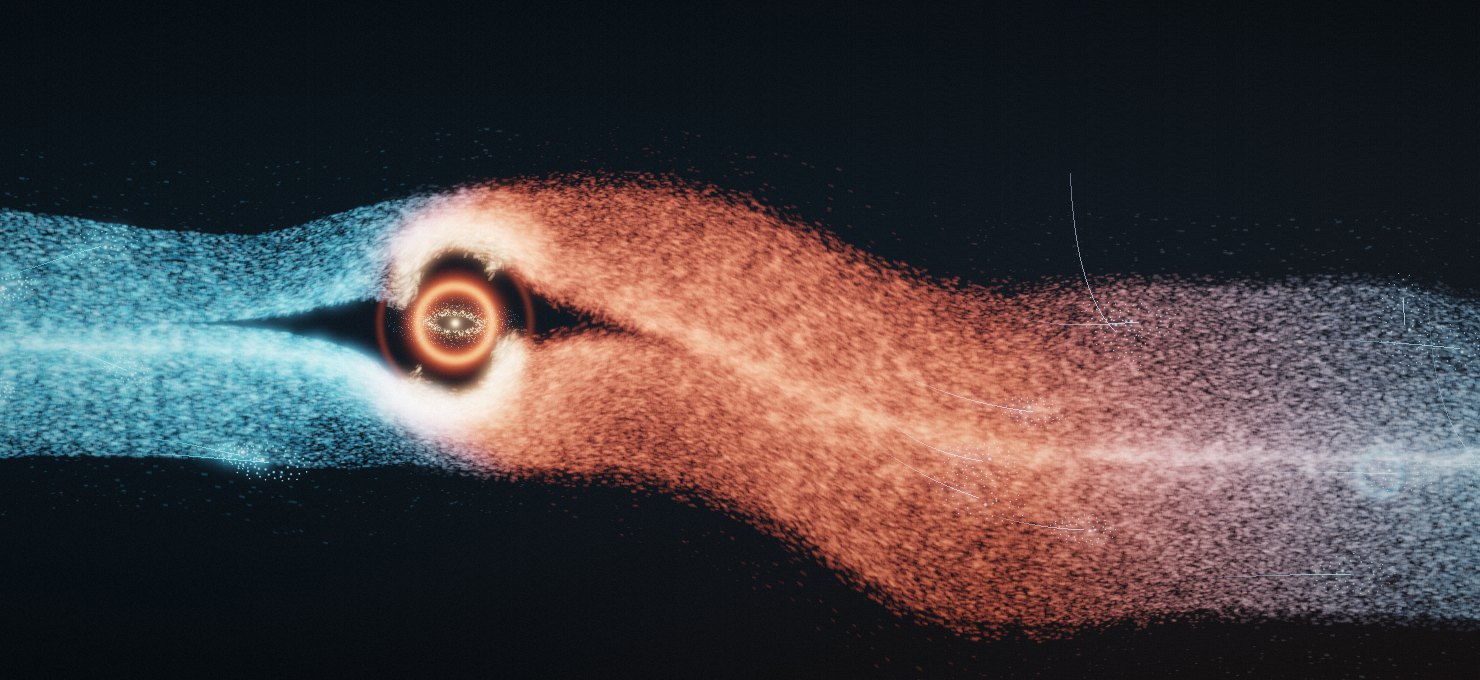
Fig. 3
The river of intelligence
Interactive
The river, running
A live model of everything above. The current is 99.9% autonomous and it does not wait for you. Drop a pebble into it and watch the swarms bend around your instruction and hold the new course, long after the moment has passed.
Open the live model →
The Breadth of the Work
This isn’t one lucky system. It’s how I work now.
The Transcript API swarm is the one I’ve described, but it’s far from alone. A ZillAPI marketing agent runs the same way. A web-network-builder ships several new websites a week: real ones, that rank in Google, surface in AI and agent search results, and pull traffic across niches like travel affiliate marketing. Developer agents work in swarms, maintaining products that already exist and building ones that don’t yet. And an ad-manager agent tunes the advertising on YouTubeToTranscript.com, a site that serves around three hundred thousand pages a day, on its own, while I watch.
All of it runs at something like ninety-nine percent autonomy. I drop in with simple feedback and step back out.
Let me put the result plainly, because the number still surprises me.
A year ago, I could do maybe 10× the work of one person. Today I can do 100× the work of one person.
Not by working harder. I work less than I used to. By climbing. More agents, more swarms, more managing of managers, and the amount of real work getting done multiplies, and keeps multiplying.
The Answer I Found
Where our work goes when the machines hold the intelligence
So, back to the only question that matters. When AI holds nearly all the intelligence, what is left for us?
This. Exactly this.
Our work moves up. All the way up, to the highest-leverage layer there is: deciding. Spending those hundred daily decisions in the most impactful way possible, on the few things only a human should decide. And here is the astonishing part: the AI does the meta-work of getting us there. It works out where our judgment is most needed. It digests the mess into the one clear question we actually have to answer. It hands us that decision in the easiest possible form, and lets us make it in the most effective possible way. And it does all of it asynchronously. The agents never sleep, never stall except when they’re waiting on us. So we engage on our own schedule, whenever we can, and drop our nuggets into the current.
Our role stops being to do the work. It becomes to steer the intelligence that does the work.
The Move to Make
None of this is science fiction. It’s available today.
I wrote something down recently that I keep coming back to:
You shouldn’t think. You should have agents think. You should make the decisions.
You shouldn’t manage agents. You should have agents manage agents. You just define strategy, desirable outputs, and direction.
And if you don’t have agents yet that can think and manage, you should set them up as soon as you possibly can.
That isn’t a prediction. It’s a description of a Tuesday. The tools to do this exist right now, and almost no one is living inside them yet. That gap, between what’s possible today and what people are actually doing, is the widest it has ever been. It is exactly where all the leverage is hiding.
So here’s the first move, and it’s smaller than you’d expect. Take one thing you do over and over. Hand it to a single agent: level one. Then teach that agent enough strategy that it stops asking you about the small stuff: level two. Then let it hire its own team: level three. Climb one level. You’ll feel your decision budget come unstuck almost immediately, and you will never want it back the way it was.
If you want a running start, CRHQ.ai is what I built to create and run these teams: a lead agent that makes most of the calls, with specialists under it doing the work.
The river is already flowing. It has been for a while now, quietly, in the background of a few people’s lives, mine among them. It doesn’t need most of us to start. It’s rising whether we wade in or not.
But it bends for whoever shows up at the bank with a pebble.
That's the future of work. Not the end of ours, but the elevation of it. Less doing, more deciding. Smaller inputs, heavier weight. A hundred decisions a day, each one dropped into a current strong enough to carry it further than a hundred of us ever could.
Go find your first pebble.